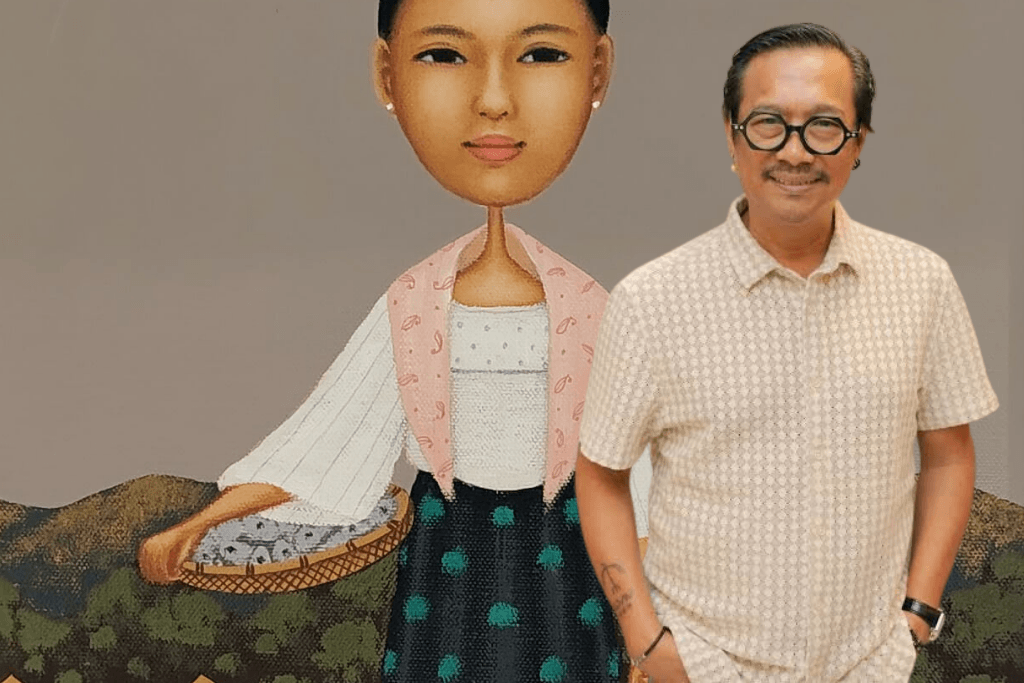
Dominic Rubio is a Filipino visual artist and a founding member of the Guevarra and Blumentritt Group. He was born in Paete, Laguna, a town known for its woodcarving tradition. He studied at the University of Santo Tomas College of Fine Arts, where he majored in commercial arts. As a result, he developed a strong foundation in both traditional and modern techniques.
Early in his career, he worked briefly as an artist at Puris Lintas, a major advertising agency in Manila. However, he later moved to Pearl Farm in Davao del Sur, where he worked as a part-time in-house artist. During this period, he traveled across the Caraga Region in Northern Mindanao. There, he learned about the Mandaya and T’boli tribes. In addition, he lived with the B’laan and Badjao communities in southern Mindanao, which further enriched his cultural perspective.
Early Exhibitions and Themes
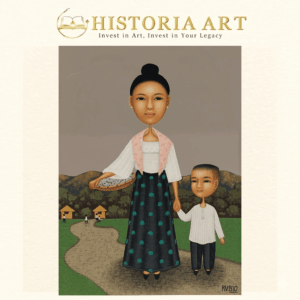
Rubio first exhibited his works in Ad Infinitum. In this exhibition, he explored themes of women, motherhood, and daily life. Moreover, his paintings portrayed ethnic Filipinas engaged in everyday activities within natural landscapes.
In 2003, he held a major exhibition at Galerie Joaquin. This show focused on Filipino women and their evolving identity. Furthermore, it featured both earlier works and updated portraits with more refined and glamorous elements. Because of this, his artistic direction became more defined.
Artistic Style and Recognition
Over time, Rubio became a favorite among collectors in Asia, the United States, and Canada. His works often feature figures in turn-of-the-century attire with elongated necks. As a result, these elements became his signature style.
Art critics have described these figures as “people types.” Through them, Rubio expresses cultural pride and identity. Consequently, his works reflect a strong sense of heritage and individuality.
International Presence and Auctions
Rubio’s artworks have performed well in international auctions. For instance, his works have appeared at Sotheby’s, Christie’s, Borobudur, Larasati, and Masterpiece. Because of this exposure, his reputation continues to grow globally.
Career Growth and Breakthrough
Born in 1970 in the Philippines, Rubio continued to refine his artistic voice. His early exhibitions focused on ethnic Filipinas as women, mothers, and cultural figures.
In 2006, he held a solo exhibition that marked a turning point in his career. As a result, he gained international recognition as a contemporary artist. During this period, he explored themes from the Philippines’ colonial past.
His compositions featured figures with long, slender necks and stylized faces. In addition, these figures often wore traditional attire. According to Rubio, “holding one’s head high” represents pride and dignity. Therefore, his works reflect a deeper message about cultural identity and national strength.
Recent Works and Artistic Direction
Today, Rubio continues to develop his signature style. Moreover, he incorporates panoramic backgrounds inspired by Philippine and Asian environments. To support this approach, he travels extensively across Asia. Through these experiences, he absorbs diverse cultures and translates them into his paintings.
Furthermore, Rubio has held numerous major exhibitions throughout his career. His works continue to gain recognition and are widely collected in Asia, the United States, and Canada. As a result, his influence in the contemporary art scene remains strong.